

'I am confident that we will achieve something big for the country through this'

Holding the AIMPLB responsible for the present state of affairs, Amber said the board never bothered to take (the issue of) triple talaq seriously, and now it was too late.
"We are not interested with facts at all. We are only interested in dealing with the legal issue," the bench said.

Here are some of the reactions to the Supreme Court verdict on Ayodhya.

'The BJP is keeping its options open and that the final decision is still tightly held.' 'That is consistent with the party's tendency to preserve suspense, avoid premature factional conflict, and use leadership selection as a way of resetting internal hierarchies.'

"Show respect to cows as it is the leader of all bovines. Its milk, ghee and butter have therapeutic properties and its meat is the cause of several diseases," translates the verse on the hoarding
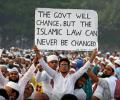
'UCC should be across India and legally applicable to every Indian citizen.'

"Over a dozen Islamic countries such as Pakistan, Tunisia, Morocco, Iran and Egypt have regulated triple talaq. If Islamic countries can regulate the practice by enacting law, and it has not been found against sharia, then how can it be wrong in India, which is a secular country?" Prasad said.
A five-judge bench headed by Chief Justice J S Khehar said it would look into the aspect whether triple talaq is part of an "enforceable" fundamental right to practice religion by Muslims.

The CBI court had on September 30, 2020 acquitted the accused including former deputy prime minister L K Advani in the case after which two Ayodhya residents -- Haji Mahboob and Syed Akhlaq -- moved a revision petition before the Allahabad high court.
Earlier, board's counsel Zafaryab Jilani had said that he is not satisfied with the verdict.

The senior advocate had represented the Muslim parties, including the Uttar Pradesh Sunni Central Waqf Board, in the case in trial court, Allahabad High Court and the Supreme Court.

'They must take the bull of conservatism within their own ranks by its horns as much as they need to speak out against the fallacies of the non-Hindutva (or 'Muslim-friendly') political forces as well,' argues Mohammad Sajjad.
'We are aggrieved about the ruling and there is no other way of putting it across to the Supreme Court and entire society that wrong has been committed and which requires correction.'

The All India Muslim Personal Law Board said that it would ask Qazis to tell bridegroom at the time of execution of 'nikahnama' that they would not resort to "three divorces in one sitting" as it was an "undesirable practice in Shariat".

Aseem Chhabra ranks the Best of 2025's films that released in theatres, or went directly to OTT platforms.
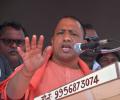
Adityanath called for an end to the Muslim practice of 'triple talaq' and advocated implementation of a common civil code in the country.

The Union law ministry will file a consolidated reply on the issue in the apex court by the end of this month.
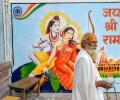
'If better sense prevails, Muslims should offer the disputed land in Ayodhya back to the government.'

'It is a welcome development, but the ordinance has limited validity of six months, that is the problem.' 'Therefore, we are urging all political parties including the Congress to collaborate and bring a law.'
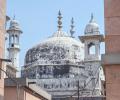
The AIMPLB contended that the object of the Act is to prevent disturbances of public order, maintain peace and tranquility, and strengthen the basic feature of secularism.
The high court further observed that the triple talaq practice, sanctioned under Muslim Personal Law that governs marriage, property and divorce violates the rights of Muslim women.
Board chairman Maulana Mirza Mohammad Athar has sent a letter to Prime Minister Manmohan Singh, copy of which had also been forwarded to the President, to arrange a correct 'tarjuma' (translation) of Vande Mataram at the earliest. He said efforts should be made to clear the controversy over the song once and for all.
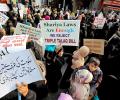
The application has been filed to oppose a batch of petitions on which the apex court had in 2018 issued notices to the Centre and other stakeholders while referring the matter to a 5-judge Constitution bench.

Amid raging controversy over Samajwadi Party supremo Mulayam Singh Yadav's claim -- that those living in relief camps in Muzaffarnagar were political activists and not riot victims -- his party went into fire fighting mode on Wednesday, saying his statement had been twisted.

'Congress gave Muslim conservatism support and here the BJP saw a window of opportunity'
The apex court had on March 30 observed that practices of 'triple talaq', 'nikah halala' and polygamy among Muslims were important issues involving "sentiments" and a Constitution bench would hear the pleas challenging these from May 11.

A five-judge Constitution bench headed by Chief Justice J Khehar will commence hearing on seven petitions
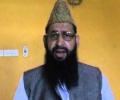
Muslim scholars on Friday trashed as "cheap publicity gimmick" and "childish" Bahujan Samaj Party leader Haji Yakub Qureshi's alleged statement hailing terrorists who truck at French satirical magazine Charlie Hebdo and demanded strict action against him.
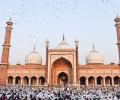
'Only because of the absence of a dedication record in writing, how can such properties be treated as located on misappropriated government land?'
Stressing that the decision of the Sunni Central Waqf Board, one of the main litigants, will have no effect on the AIMPLB decision, Jilani said the board has already taken a final decision in this regard in its meeting on November 17.
Tthe Jamiat Ulema-e-Hind said it opposes the UCC as it is "totally against the religious freedom and fundamental rights guaranteed to the citizens in Articles 25 and 26 of the Constitution."

Taking a strong stand against the call by its ally Shiv Sena for the scrapping of Muslims' voting rights, the government today said such suggestions were not acceptable to it and that these "should not be discussed even hypothetically".
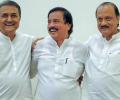
'Pro-incumbency worked big time for the ruling party.' 'It has never happened in the past of pro-incumbency working so much for the ruling party.'

Is it a divine, sacrosanct university, a holy cow, prohibiting human intervention?

The meeting is seen as part of efforts by the RSS and the BJP to reach out to the Muslim community and send out a message of peace and harmony.

The Supreme Court on Thursday fixed May 11 for commencement of hearing on pleas challenging the validity of triple talaq, 'nikah halala' and polygamy practices among Muslims.

Do you agree with the minorities' viewpoint that that the government is enforcing 'Hindu practices' on them forcefully?
